Publications
Publications by categories in reversed chronological order. Please get in touch via email if you cannot access any publications but want a copy.
Working Papers / Work in Progress
- Under ReviewReputation as Transformational Mechanism: A Hybrid Simulation of Micro-Macro Dynamics in Entrepreneurial EcosystemsBernd Wurth, Niall MacKenzie, and Susan Howick
Entrepreneurial ecosystem research has identified the structural conditions that foster productive entrepreneurship. However, explaining how micro-level actions aggregate into macro-level outcomes remains a fundamental challenge. We address this aggregation problem by focusing on university-firm interactions, identifying universities’ entrepreneurial reputation as a transformational mechanism that helps bridge the micro-macro divide. Reputation is inherently relational, accumulating through individual university-firm interactions, yet its consequences are systemic, reshaping partner preferences and ecosystem hierarchies. These theoretical properties create methodological demands that conventional approaches cannot meet. We develop a hybrid system dynamics agent-based simulation grounded in data from Scottish universities and UK firms that traces the complete causal pathway from micro-level exchanges to macro-level restructuring. Our findings reveal three key insights. First, the relationship between university investment and entrepreneurial ecosystem outcomes is fundamentally nonlinear; investments must reach critical thresholds before triggering self-reinforcing reputation dynamics. Second, entrepreneurial ecosystem outcomes emerge from competitive interdependencies that cannot be understood by examining individual actors in isolation. Third, entrepreneurial reputation operates as a partial substitute for research prestige for universities, enabling less research-intensive universities to improve their ecosystem position through strategic investment and repeated engagement. We contribute to microfoundational theory by specifying the mechanism of aggregation, extend resource orchestration theory to entrepreneurial ecosystem contexts where returns depend on interdependent actors, and demonstrate how hybrid simulation can operationalise multi-level theorising in complex systems.
Previous version presented at the 85th Annual Meeting of the Academy of Management (AOM 2025).
- Under ReviewCapturing Emergent Behaviour in Hybrid System Dynamics Agent-Based SimulationsBernd Wurth, Niall MacKenzie, and Susan Howick
Hybrid simulations (HS) combining system dynamics (SD) and agent-based modelling (ABM) have emerged as powerful tools for studying complex systems in various domains. However, current practices often rely on simple state aggregation to link ABMs to SD modules, overlooking the richness of emergent behaviours. These emergent behaviours manifest as distinctive patterns of agent interactions and sequences of state changes over time, rather than as isolated individual states. This paper presents a novel framework for capturing and integrating such emergent behavioural patterns, which we term ‘behavioural signatures’ (BehSig), from ABMs into the SD module in a HS, addressing a critical gap in existing HS modelling practices. We introduce three mechanisms: (1) post-simulation BehSig analysis, (2) BehSig aggregation into SD stocks, and (3) BehSig triggering model reconfiguration. This approach extends current frameworks by enabling a more nuanced representation of emergent phenomena within HS. The additional insights that this framework provides are demonstrated through a case study of university-industry collaboration, revealing behaviours of the system that commonly used HS designs cannot capture. Our approach addresses key limitations in current practices, including inadequate representation of emergent phenomena and oversimplification of agent-based dynamics. By facilitating bi-directional micro-macro feedback beyond simple state aggregation, this framework aligns with recent advancements in ABM and multi-level modelling. It contributes to operational research by enhancing hybrid SD-ABM models’ capabilities to capture complex system behaviours. We discuss implementation challenges and provide implications for theory and practice, offering a foundation for more sophisticated HS across various domains in operational research.
- Working PaperProcess Velocity in New Ventures: Persistence Accelerates and Diversity DelaysSophia Hess, Bernd Wurth, and Andreas Wahl
Process velocity, defined as the rate at which ventures achieve key developmental milestones, represents a critical but understudied dimension of new venture performance. While research has established that milestone achievement predicts venture success, we know far less about what determines how quickly ventures reach these milestones. Drawing on momentum theory, dynamic states, and resource orchestration perspectives, we develop a process velocity framework examining how entrepreneurial persistence, founding team heterogeneity, and ecosystem access shape the timing of first sales, first employee hires, and first funding. Using accelerated failure time survival models on 288 new ventures, we find that persistence accelerates milestone achievement for sales and funding, with the strongest effects on funding acquisition. Team heterogeneity delays milestone achievement, particularly for sales and hiring, revealing a ‘liability of diversity’ in nascent ventures: coordination costs outweigh informational benefits before teams develop shared mental models and integrative mechanisms. Ecosystem access significantly accelerates commercialization but shows no effect on hiring or funding. We make three contributions. First, we advance a process velocity perspective that shifts attention from whether ventures achieve milestones to how quickly they achieve them. Second, we reposition persistence as a temporal capability that sustains momentum through feedback-rich early development. And third, we identify temporal boundary conditions for diversity effects that challenge assumptions of uniform benefits. These findings carry implications for team composition decisions, investor evaluation criteria, and ecosystem program design.
Accepted for presentation and the Proceedings at the 86th Annual Meeting of the Academy of Management (AOM 2026).
- Working PaperClosing the Loop: A Systems Theory of Entrepreneurial Action and TimeBernd Wurth, Bob Walrave, Georges Romme, and 1 more author
Entrepreneurship research has long recognised that entrepreneurship unfolds through time, yet dominant theoretical frameworks remain largely static. This paper develops a dynamic systems theory of entrepreneurial action that is built on four core principles, namely feedback loops that connect goals/beliefs and decisions/actions to results and environmental responses; temporal delays that separate cause from observable effect; stock–flow accumulation processes; and non-linear dynamics including thresholds and tipping points. We demonstrate how this perspective provides a foundation for previously only loosely connected theoretical streams such as judgment-based approaches, effectuation, the theory-based view, and (entrepreneurial) ecosystems by revealing them as complementary descriptions of nested feedback systems operating at different timescales and levels of aggregation. The framework shows that entrepreneurs operate within learning loops whose effectiveness depends on delay structures; that ventures exhibit characteristic dynamic patterns emerging from underlying feedback architectures; and that ecosystems shape individual action through parameter modification. We reconceptualise external enablers as interventions that modify feedback structure (e.g., reducing delays, lowering thresholds, restructuring loops, or building stocks). Our primary contribution is demonstrating that dynamic systems thinking constitutes the missing theoretical architecture for cumulative theory building about entrepreneurship as process.
Accepted for presentation at the 86th Annual Meeting of the Academy of Management (AOM 2026).
- Work in ProgressAre We Really Talking About Entrepreneurial Universities?Bernd Wurth, and Niall MacKenzie
Accepted Catalyst proposal at Journal of Product Innovation Management.
- Work in ProgressElgar Encyclopaedia of Entrepreneurial EcosystemsErik Stam, Bernd Wurth, Suzanne Mawson, and 1 more author
This comprehensive encyclopaedia will feature around 70 entries covering all aspects of entrepreneurial ecosystems, from theoretical foundations to practical applications. We’re bringing together leading voices to create an authoritative resource that will serve researchers, students, and policymakers for years to come.
The encyclopaedia is expected to be published in 2027.
Publications
2026
- Chapter
 Researching ecosystem dynamics: system dynamics and agent-based modelling as tools for entrepreneurial ecosystem researchBernd Wurth, Bob Walrave, Georges Romme, and 1 more authorIn Advancing Entrepreneurial Ecosystems Research: Concepts for Regional Entrepreneurship Ecologists, Edward Elgar, Cheltenham, UK, 2026
Traditional methodologies often fail to capture the complex dynamics of entrepreneurial ecosystems. This chapter introduces system dynamics (SD) and agent-based modelling (ABM) as advanced tools for analysing and theorising about these ecosystems. These approaches offer an ecologically grounded perspective aligned with the realist nature of ecosystems. SD provides a top-down view, capturing internal dynamics and external influences, while ABM offers a bottom-up lens, focusing on detailed interactions among actors. The chapter discusses the strengths, applications, and limitations of both methodologies, highlighting the potential of hybrid simulations. By integrating these approaches with other research techniques, we promote the development of a comprehensive understanding of entrepreneurial ecosystems, incorporating both subjective and objective viewpoints. A high-level tutorial on model development is included, guiding academics and policymakers towards a profound, ecologically informed understanding of entrepreneurial ecosystems.
@inbook{wurwalrom26, title = {Researching ecosystem dynamics: system dynamics and agent-based modelling as tools for entrepreneurial ecosystem research}, booktitle = {Advancing Entrepreneurial Ecosystems Research: Concepts for Regional Entrepreneurship Ecologists}, author = {Wurth, Bernd and Walrave, Bob and Romme, Georges and Stam, Erik}, editor = {O’Connor, Allan}, publisher = {Edward Elgar}, location = {Cheltenham, UK}, year = {2026}, doi = {10.4337/9781035336623.00022}, google_scholar_id = {pqnbT2bcN3wC}, } - Article
 The future of entrepreneurial ecosystems research: Toward a policy-oriented research agendaFarsan Madjdi, and Bernd WurthJournal of Business Venturing Insights, 2026
Artificial intelligence (AI) is widely portrayed as enhancing entrepreneurial decision-making through improved prediction, pattern recognition, and data-driven evaluation. Yet entrepreneurship frequently unfolds under conditions of Knightian uncertainty, where action depends on entrepreneurial judgment about uncertain and evolving futures rather than calculable prediction alone. We theorize how AI-based systems reshape the epistemic conditions under which entrepreneurial beliefs are formed and evaluated. We argue that AI systems are not epistemically neutral: by generating plausibility signals from historical data, they influence which ventures appear credible and worthy of support. We conceptualize these dynamics as AI-mediated plausibility regimes and identify a dual epistemic risk. In generative modes, AI may inflate evaluative confidence beyond what the available epistemic grounding warrants (false positives). In evaluative and screening modes, AI may disadvantage low-precedent but potentially transformative ventures (false negatives). By distinguishing these system classes and their distributional effects, we specify when AI may expand entrepreneurial imagination and when it may narrow entrepreneurial variety.
@article{madwur26,
  title = {The future of entrepreneurial ecosystems research: Toward a policy-oriented research agenda},
  author = {Madjdi, Farsan and Wurth, Bernd},
  journal = {Journal of Business Venturing Insights},
  volume = {26},
  pages = {e00644},
  year = {2026},
  doi = {10.1016/j.jbvi.2026.e00644},
  google_scholar_id = {HoB7MX3m0LUC},
}


2025
- Article
 The future of entrepreneurial ecosystems research: Toward a policy-oriented research agendaSophia Hess, Bernd Wurth, Erik Stam, and 9 more authorsJournal of Business Venturing Insights, 2025
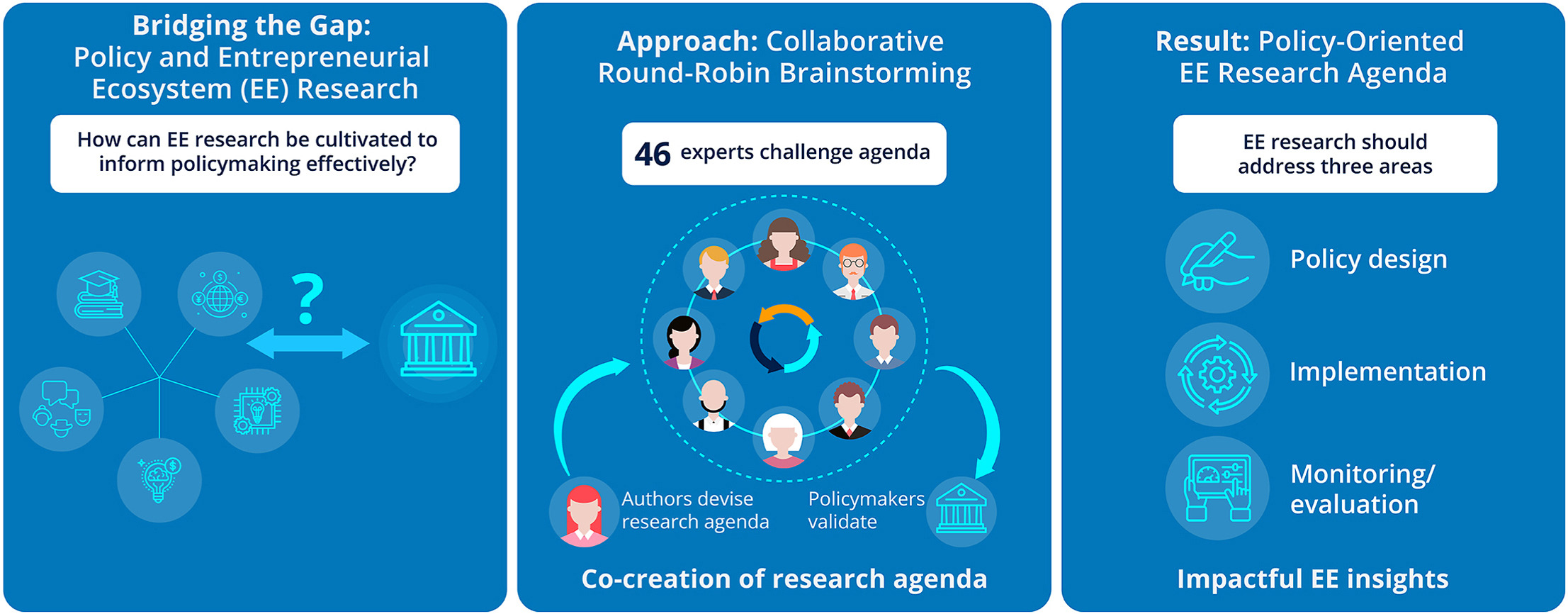
Entrepreneurial ecosystem (EE) research has contributed to reshaping entrepreneurial policy and practice. Despite significant translational efforts, the gap between theory and actionable policy seems to be widening. This paper adopts a collaborative approach and critically reflects on the alignment of EE research with practical policy needs, structured around an interactive round-robin brainstorming with 58 EE scholars (i.e., 12 authors and 46 additional experts). We examine policy adoption in the context of EE, discussing the challenges and evolution of research methods, data, and theory. We propose a future policy-oriented research agenda, validated and prioritized by European policymakers, to ensure that EE research effectively informs entrepreneurship policy.
@article{heswursta25,
  title = {The future of entrepreneurial ecosystems research: Toward a policy-oriented research agenda},
  author = {Hess, Sophia and Wurth, Bernd and Stam, Erik and Giones, Ferran and Fini, Riccardo and Cavallo, Angelo and Wahl, Andreas and Bosma, Niels and Theodoraki, Christina and Chabaud, Didier and Brem, Alexander and Kuckertz, Andreas},
  journal = {Journal of Business Venturing Insights},
  volume = {23},
  pages = {e00538},
  year = {2025},
  doi = {10.1016/j.jbvi.2025.e00538},
  google_scholar_id = {g5m5HwL7SMYC},
}


2024
- Article
 Beyond words: How visual imagery shapes collaborative sensemaking in entrepreneurial ecosystemsBernd Wurth, and Suzanne MawsonJournal of Business Venturing Insights, 2024
Entrepreneurial ecosystems (EEs) are complex social systems dependent on connectivity and shared understanding between diverse actors. An often used, albeit oversimplified view, implies that diverse actors connect, collaborate and contribute to the EE in an almost frictionless way. However, this perspective overlooks the need for deeper forms of communication that can shift actors’ perceptions, goals and motivations to trigger meaningful change. Recent research has highlighted the role of conversations, narratives and stories in developing (informal) institutions and shared understandings. What is missing from this discussion, however, are non-verbal forms of communication, which enable interpretation, support meaning-making and help implementation. This paper draws on communicative institutionalism theory and empirical observations from a larger participatory action research project. We discuss how visuals support richer interpretation of ambiguities, different perspectives and collaborative sensemaking. Images act as boundary objects enabling creative associations, revealing assumptions and catalysing explorative dialogue through inherent ambiguity. Representing complex concepts visually facilitates participant engagement over time. The co-creative process of iterative illustration also captures shared meaning as it emerges. Implications highlight visuals’ potential for fostering future-oriented dialogue, reflective practice and embodied institutions fundamental for EEs. From this, we outline suggestions for further research and practice.
@article{wurmaw24, title = {Beyond words: How visual imagery shapes collaborative sensemaking in entrepreneurial ecosystems}, author = {Wurth, Bernd and Mawson, Suzanne}, journal = {Journal of Business Venturing Insights}, volume = {21}, pages = {e00458}, year = {2024}, doi = {10.1016/j.jbvi.2024.e00458}, google_scholar_id = {2P1L_qKh6hAC}, } - Article
 Not seeing the forest for the trees? A systems approach to the entrepreneurial universityBernd Wurth, Niall MacKenzie, and Susan HowickSmall Business Economics, 2024
The idea and practice of the entrepreneurial university has emerged in response to growing expectations of universities contributing to economic development and has, in turn, been subject to a growing body of research. However, much of the work is focused on individual activities or institutions, typically overemphasising commercialisation activities and certain types of universities. Furthermore, much of this research is de-contextualised and does not consider the systems in which universities operate. As a result, we have a variety of unit theories of constituent parts of the entrepreneurial university without considering the wider (feedback) effects and implications — in other words: we are, in effect, not seeing the forest for the trees. Drawing on in-depth quantitative and qualitative field work and the literature, we develop a programmatic theory of the entrepreneurial university and the institutionalised entrepreneurial activities. Using causal loop diagrams, we capture the systemness and the interdependencies between universities’ entrepreneurial activities and their dynamic capabilities. The model highlights how universities are part of a larger system and how this influences their external engagement activities. The result is a more holistic understanding of entrepreneurial universities that reconciles existing work and guides future research. We discuss practical implications and policy levers derived from this systemic perspective.
@article{wurmachow24, title = {Not seeing the forest for the trees? A systems approach to the entrepreneurial university}, author = {Wurth, Bernd and MacKenzie, Niall and Howick, Susan}, journal = {Small Business Economics}, volume = {63}, number = {2}, pages = {673--696}, year = {2024}, doi = {10.1007/s11187-023-00864-1}, dimensions = {true}, google_scholar_id = {70eg2SAEIzsC}, } - Chapter
 Combining SD & ABM: Frameworks, benefits, challenges, and future research directionsSusan Howick, Itamar Megiddo, Le Khanh Ngan Nguyen, and 2 more authorsIn Hybrid Modeling and Simulation: Conceptualizations, Methods, and Applications, Springer, Cham, 2024
System Dynamics (SD) and Agent-Based modelling (ABM) are two commonly used simulation methods with different characteristics and benefits. When tackling a complex problem, the use of one of these methods may be insufficient and, instead, a combination of the two methods in a hybrid simulation may be required. To support modellers in the development of SD-ABM hybrid simulations, this chapter provides a comprehensive overview of methodological and practical considerations. Frameworks are presented to facilitate the implementation of hybrid SD-ABM models including the development of a conceptual SD-ABM hybrid model. The chapter then presents key benefits associated with SD-ABM hybrid modelling, which include being able to model an appropriate level of complexity, facilitate communication of the model design, enhance confidence building and reduce compute intensity. Two case studies are used to illustrate these benefits. Although there are many benefits, there are also key challenges associated with the development of a SD-ABM hybrid model and these are discussed. The chapter concludes with a discussion of opportunities and areas for future research.
@inbook{howmegngu24,
  title = {Combining SD & ABM: Frameworks, benefits, challenges, and future research directions},
  booktitle = {Hybrid Modeling and Simulation: Conceptualizations, Methods, and Applications},
  author = {Howick, Susan and Megiddo, Itamar and Nguyen, Le Khanh Ngan and Wurth, Bernd and Kazakov, Rossen},
  editor = {Fakhimi, M. and Mustafee, Navonil},
  publisher = {Springer},
  location = {Cham},
  year = {2024},
  doi = {10.1007/978-3-031-59999-6_9},
  google_scholar_id = {ldfaerwXgEUC},
}


2023
- Article
 Entrepreneurial Ecosystem MechanismsBernd Wurth, Erik Stam, and Ben SpigelFoundations and Trends in Entrepreneurship, also published as a book (ISBN: 978-1-63828-256-3) , 2023
Entrepreneurial ecosystems have developed from a powerful idea and concept into a transdisciplinary research program, increasing our understanding into entrepreneurship-led development and providing actionable knowledge for improving the conditions for entrepreneurship and development. In this monograph we take stock of the progress to date and synthesize the findings of 181 empirical scientific entrepreneurial ecosystem studies through a systematic literature review. We organize the review around five key mechanisms that explain the nature and development of entrepreneurial ecosystems: (1) interdependence of its elements, (2) upward causation explaining entrepreneurial ecosystem outputs and (3) outcomes, (4) downward causation and path dependence, and (5) inter-ecosystem links. We summarize the findings and outline opportunities for research and discuss policy implications in the light of a transdisciplinary entrepreneurial ecosystem research program. This monograph is of interest for scholars of all academic disciplines that provide knowledge that is relevant for the understanding of entrepreneurial ecosystems, entrepreneurship and entrepreneurship-led development, but also for all stakeholders involved in the development of entrepreneurial ecosystems.
@article{wurstaspi23,
  title = {Entrepreneurial Ecosystem Mechanisms},
  author = {Wurth, Bernd and Stam, Erik and Spigel, Ben},
  journal = {Foundations and Trends in Entrepreneurship},
  volume = {19},
  number = {3},
  pages = {224--339},
  year = {2023},
  doi = {10.1561/0300000089},
  google_scholar_id = {35N4QoGY0k4C},
}


2022
- Article
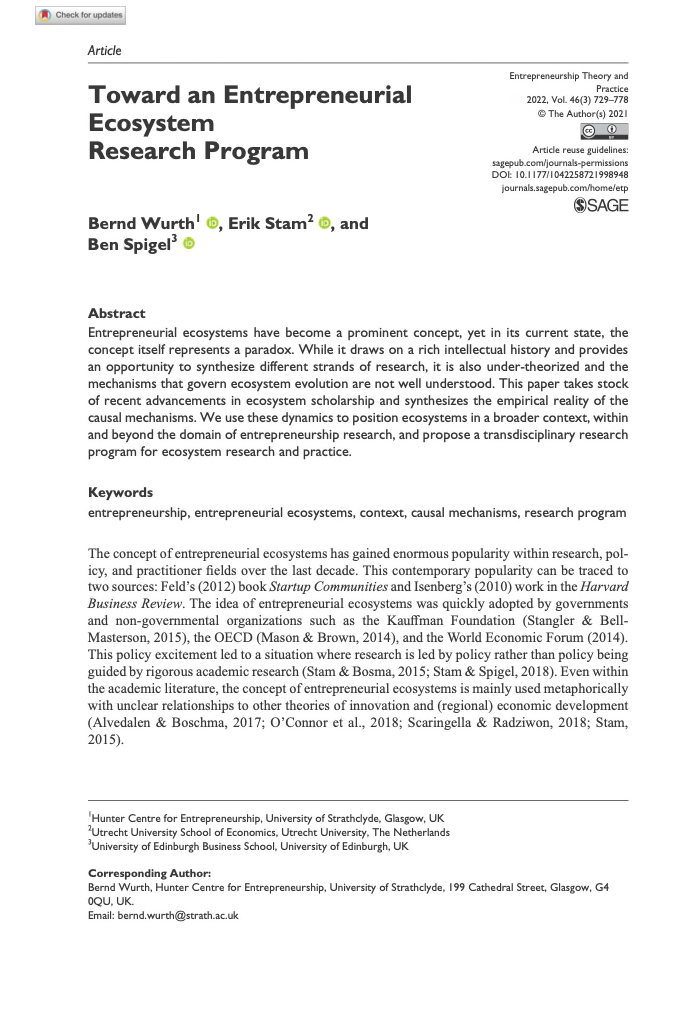 Toward an Entrepreneurial Ecosystem Research ProgramBernd Wurth, Erik Stam, and Ben SpigelEntrepreneurship Theory and Practice, 2022
Entrepreneurial ecosystems have become a prominent concept, yet in its current state, the concept itself represents a paradox. While it draws on a rich intellectual history and provides an opportunity to synthesize different strands of research, it is also under-theorized and the mechanisms that govern ecosystem evolution are not well understood. This paper takes stock of recent advancements in ecosystem scholarship and synthesizes the empirical reality of the causal mechanisms. We use these dynamics to position ecosystems in a broader context, within and beyond the domain of entrepreneurship research, and propose a transdisciplinary research program for ecosystem research and practice.
@article{wurstaspi22, title = {Toward an Entrepreneurial Ecosystem Research Program}, author = {Wurth, Bernd and Stam, Erik and Spigel, Ben}, journal = {Entrepreneurship Theory and Practice}, volume = {46}, number = {3}, pages = {729--778}, year = {2022}, doi = {10.1177/1042258721998948}, dimensions = {true}, google_scholar_id = {J_g5lzvAfSwC}, } - Article
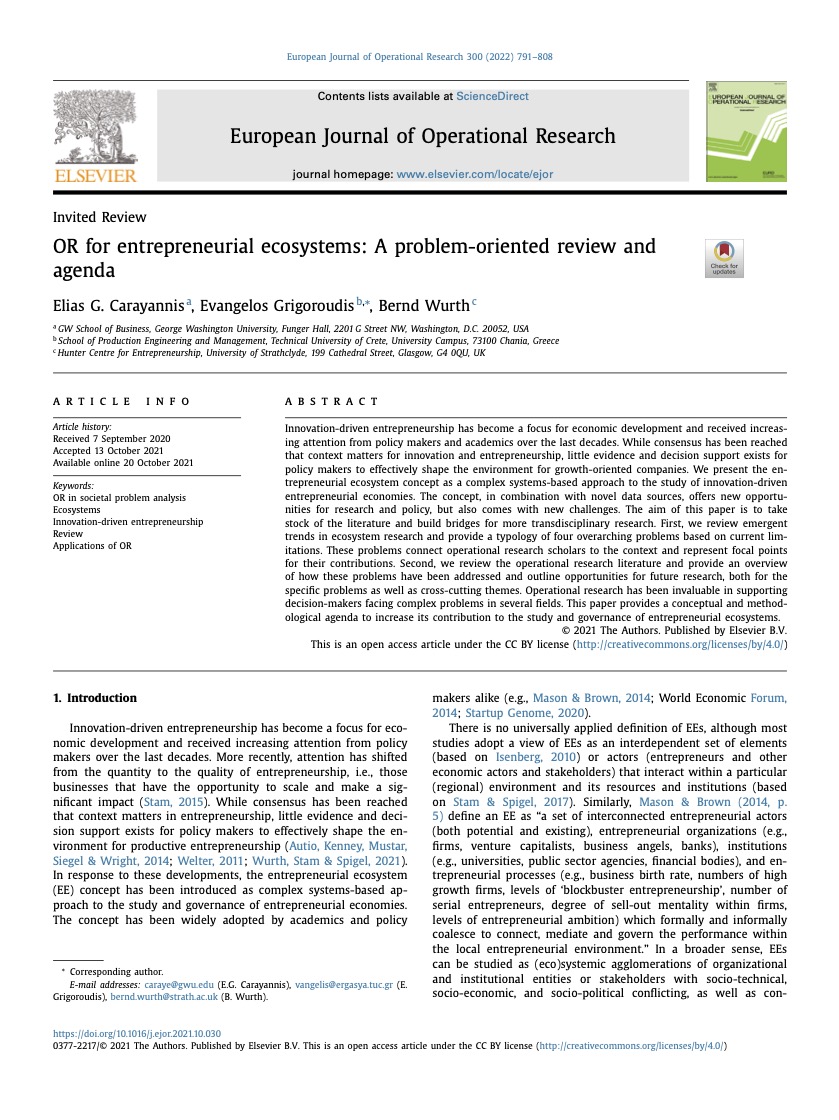 OR for Entrepreneurial Ecosystems: A Problem-Oriented Review and AgendaElias G. Carayannis, Evangelos Grigoroudis, and Bernd WurthEuropean Journal of Operational Research, 2022
Innovation-driven entrepreneurship has become a focus for economic development and received increasing attention from policy makers and academics over the last decades. While consensus has been reached that context matters for innovation and entrepreneurship, little evidence and decision support exists for policy makers to effectively shape the environment for growth-oriented companies. We present the entrepreneurial ecosystem concept as a complex systems-based approach to the study of innovation-driven entrepreneurial economies. The concept, in combination with novel data sources, offers new opportunities for research and policy, but also comes with new challenges. The aim of this paper is to take stock of the literature and build bridges for more transdisciplinary research. First, we review emergent trends in ecosystem research and provide a typology of four overarching problems based on current limitations. These problems connect operational research scholars to the context and represent focal points for their contributions. Second, we review the operational research literature and provide an overview of how these problems have been addressed and outline opportunities for future research, both for the specific problems as well as cross-cutting themes. Operational research has been invaluable in supporting decision-makers facing complex problems in several fields. This paper provides a conceptual and methodological agenda to increase its contribution to the study and governance of entrepreneurial ecosystems.
@article{cargriwur22,
  title = {OR for Entrepreneurial Ecosystems: A Problem-Oriented Review and Agenda},
  author = {Carayannis, Elias G. and Grigoroudis, Evangelos and Wurth, Bernd},
  journal = {European Journal of Operational Research},
  volume = {300},
  number = {3},
  pages = {791--808},
  year = {2022},
  doi = {10.1016/j.ejor.2021.10.030},
  google_scholar_id = {vV6vV6tmYwMC},
}




2020
- Thesis
 Simulating Academic Entrepreneurship and Inter-Organisational Collaboration in University Ecosystems: A Hybrid System Dynamics Agent-Based SimulationBernd Wurth2020
Universities are increasingly expected to actively contribute to socio-economic development. Academic entrepreneurship and the evolution of the entrepreneurial university within ecosystems have received increasing attention from both policymakers and academic communities over the last decades. However, most studies on universities’ external engagement have focused on individual activities and single universities, hereby neglecting the feedback effects between different activities and how universities are linked through an overlap of their ecosystems. The result is an incomplete understanding of how universities interact with their ecosystem and the resulting inter- and intra-organisational dynamics. This research addresses this issue by developing a hybrid system dynamics agent-based model, which captures feedback structure and the internal decision-making of universities and companies. Both the conceptual and simulation model are based on a triangulation of the literature, interviews with representatives of Scottish universities, and secondary data for Scottish universities and UK businesses. This research makes several theoretical, methodological, and empirical contributions. From a theoretical perspective, it contributes in two distinct ways to the field of entrepreneurship by defining university ecosystems in new way that provides a basis for future research and developing a multi-modal simulation model that can be applied in tested in different contexts. The methodological contributions to the field of modelling and simulation in management science include a modelling process for hybrid simulations, new practices for modelling the size of agent populations through different designs of stocks and flows in the system dynamics module in hybrid simulations, and complex events for recognising emergent behaviour. Lastly, this research makes two empirical contributions to the field of entrepreneurship. This research shines a light on the dynamics of academic entrepreneurship and how universities can partially overcome a low research prestige to increase academic entrepreneurship. Implications for policy and practice are outlined and opportunities for future research conclude this thesis.
@book{wur20,
  title = {Simulating Academic Entrepreneurship and Inter-Organisational Collaboration in University Ecosystems: A Hybrid System Dynamics Agent-Based Simulation},
  author = {Wurth, Bernd},
  publisher = {University of Strathclyde},
  year = {2020},
  google_scholar_id = {NaGl4SEjCO4C},
}


2019
- Article
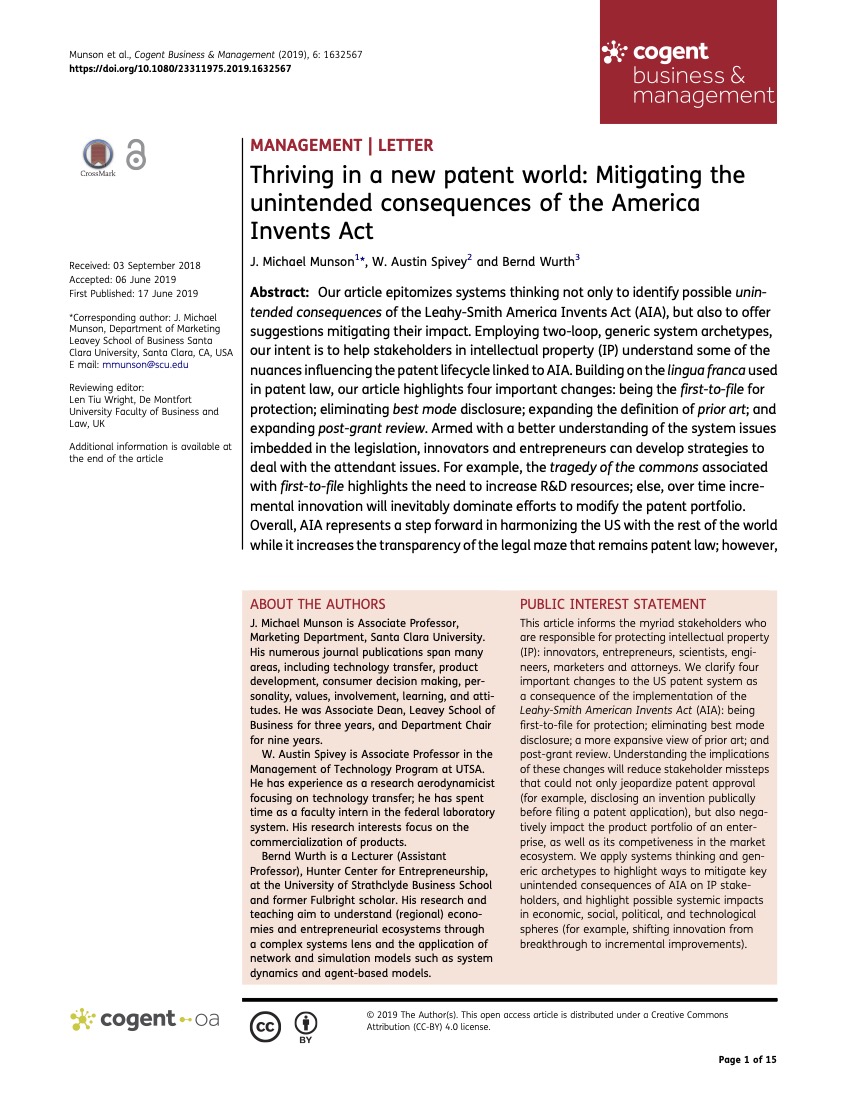 Thriving in a new patent world: Mitigating the unintended consequences of the America Invents ActJ. Michael Munson, W. Austin Spivey, and Bernd WurthCogent Business & Management, 2019
Our article epitomizes systems thinking not only to identify possible unintended consequences of the Leahy-Smith America Invents Act (AIA), but also to offer suggestions mitigating their impact. Employing two-loop, generic system archetypes, our intent is to help stakeholders in intellectual property (IP) understand some of the nuances influencing the patent lifecycle linked to AIA. Building on the lingua franca used in patent law, our article highlights four important changes: being the first-to-file for protection; eliminating best mode disclosure; expanding the definition of prior art; and expanding post-grant review. Armed with a better understanding of the system issues imbedded in the legislation, innovators and entrepreneurs can develop strategies to deal with the attendant issues. For example, the tragedy of the commons associated with first-to-file highlights the need to increase R&D resources; else, over time incremental innovation will inevitably dominate efforts to modify the patent portfolio. Overall, AIA represents a step forward in harmonizing the US with the rest of the world while it increases the transparency of the legal maze that remains patent law; however, the changes bring allocation issues, secrecy, and time pressure to the forefront of the conversation about new product development. Recognition of these impacts is relevant worldwide for anyone contemplating a US patent or any entity attempting to maintain a viable portfolio of intellectual property.
@article{munspiwur19, title = {Thriving in a new patent world: Mitigating the unintended consequences of the America Invents Act}, author = {Munson, J. Michael and Spivey, W. Austin and Wurth, Bernd}, journal = {Cogent Business & Management}, volume = {6}, number = {1}, pages = {1632567}, year = {2019}, doi = {10.1080/23311975.2019.1632567}, google_scholar_id = {BqipwSGYUEgC}, } - Report
 Growing Entrepreneurial Ecosystems: A Handbook for HEIsJonathan Levie, and Bernd Wurth2019
Scotland has an ambitious goal to become a world-leading entrepreneurial and innovative country. As part of these efforts, Scotland participated in the MIT Regional Entrepreneurship Acceleration Program (REAP) from 2012 to 2014. A key issue identified by REAP was the role of Higher Education Institutions (HEIs) in Scotland’s innovation-driven entrepreneurial ecosystem. While HEIs have accelerated their engagement with industrial and other external partners and promotion and support of entrepreneurial behaviour among students and staff, particularly in recent years (Universities Scotland, 2018a), the REAP Scotland report identified that there was scope to share best practice. Funded by Highlands and Islands Enterprise (HIE) and led by REAP core team member Prof Jonathan Levie (University of Strathclyde) and the REAP Universities High Level Task Group (UHLTG), four interactive and practice-oriented best practice workshops were conducted to address this issue: ‘Mapping University Ecosystems’ (2015, University of Dundee), ‘Incubators and Accelerators’ (2015, Elevator, Aberdeen), ‘Enterprise Education’ (2016) and an ‘Ecosystem Exchange Activity’ (2018), both at the University of Strathclyde, Glasgow). On the basis of these workshops and the state-of-the-art of the academic literature on entrepreneurial universities, this report presents a process-oriented framework for HEI entrepreneurial ecosystems to nurture entrepreneurial activities among staff, students, and graduates. HEI entrepreneurial ecosystems emerge from the “strategic and collective actions of various organizational components [...] in order to maximize both the entrepreneurial and innovative contributions of universities” (Hayter, 2016, p. 634). To enable this: 1. HEIs should understand their own entrepreneurial ecosystem and create a supportive environment for its development. This environment includes an entrepreneurial and innovative culture; policies that support and reward entrepreneurial activities; and efforts to connect staff, students, and alumni; all coordinated and promoted through a clear vision and strategy. 2. HEIs should develop clear internal pathways for entrepreneurial staff, students and alumni and constantly monitor their effectiveness and adjust if necessary. Many HEIs offer a variety of programmes and different ways of supporting entrepreneurial students, staff and alumni. The challenge for most HEIs is to provide a clear path for their constituents in order to help them navigate through the opportunities and resources that are available to them. 3. Technology-based ventures typically need more resources than a HEI on its own can provide. At the other end of the spectrum of external resource need, artists and freelancers can also benefit from connections to the wider ecosystem. HEIs therefore need to collaborate with the wider ecosystem to leverage additional resources. For HEIs, it is important to show how engaging with external organisations can be valuable, to whom they are of value, and how and when this fits within the internal pathway. Furthermore, many HEIs have a particular regional mission. As entrepreneurial ecosystems are increasingly recognised to be regional rather than national phenomena, some HEIs have the opportunity to become leading stakeholders in the entrepreneurial ecosystem of their city or region. We extend those three recommendations and provide a more holistic perspective for Scottish HEIs as a group, enabling them to contribute more to Scotland’s entrepreneurial ecosystem, to implement sustainable policies and structures that link to current national policies, and incorporate lessons that other institutions have learned from experience. In particular, HEIs should take the following steps: 1. There is a continuing need to cultivate collaboration among HEI enterprise-related staff at all levels and between them and relevant ecosystem stakeholders such as the Scottish Institute for Enterprise and entrepreneurial alumni. While innovativeness at the institutional ecosystem level is a necessary ingredient, it is not sufficient. If individual HEIs, like other wider ecosystem stakeholders, are too focused on their own activities and policies, their efforts will remain fragmentary and undervalued. 2. The standard metrics are “convenient to collect, keep the funding bodies happy but do not tell you much about what is really happening” (Graham, 2014, p. 8). While metrics cannot be avoided for HEIs, learning, skills and education must be at the heart of all metrics and both business formation (quantity of entrepreneurship) and start-up performance (quality of entrepreneurship) should be secondary objectives. 3. A more radical concept raised by some participants is ecosystem experimentation, perhaps funded by a prize fund where proposals for experiments that could enhance HEI entrepreneurial ecosystems. Results would be published and successful experiments could be replicated or adapted across the HEI community. While a small series of workshops and events cannot cover all challenges and opportunities, the discussions during the workshops have shown that this series has addressed at least some of the key enterprise issues facing Scottish HEIs. Feedback from all four workshops was very positive. Overall, participants recognised the value in working with like-minded people at different levels in different organisations, the opportunity to make new connections, establish relationships, and to exchange ideas, best practices and learn from each other.
@book{levwur19,
  title = {Growing Entrepreneurial Ecosystems: A Handbook for HEIs},
  author = {Levie, Jonathan and Wurth, Bernd},
  publisher = {Highlands and Islands Enterprise},
  year = {2019},
  google_scholar_id = {hMod-77fHWUC},
}


2014
- Article
 Implications of the America Invents Act for R&D Managers: Connecting the Patent Life Cycle with the Technology Development ProcessW. Austin Spivey, J. Michael Munson, and Bernd WurthResearch-Technology Management, 2014
Protecting intellectual property is crucial for R&D managers. The Leahy-Smith America Invents Act (AIA), which overhauled the US patent system in order to reduce litigation and bring US patent practices into line with international systems, offers new opportunities and challenges in this arena. AIA focuses on improving efficiency, increasing transparency, and harmonizing with other national patent regimes. In pursuit of these aims, the law introduced several key changes: eliminating the requirement for “best mode” disclosure, expanding the definition of prior art, moving from first-to-invent to first-to-file as the key criteria for patent eligibility, and adding post-grant review, among others. Using two familiar frameworks, the patent life cycle and the Stage-Gate model for new product development, the paper explores how AIA impacts R&D managers’ considerations around intellectual property. The law comes with added risks for R&D managers, who now must evaluate the commercial potential of innovation much earlier (with a larger set of stakeholders), while maintaining more secrecy than was required under the old regime. The demands of AIA require that R&D managers become more important members of the enterprise’s strategic team.
@article{spimunwur14,
  title = {Implications of the America Invents Act for R&D Managers: Connecting the Patent Life Cycle with the Technology Development Process},
  author = {Spivey, W. Austin and Munson, J. Michael and Wurth, Bernd},
  journal = {Research-Technology Management},
  volume = {57},
  number = {5},
  pages = {43--51},
  year = {2014},
  doi = {10.5437/08956308X5705255},
  dimensions = {true},
  google_scholar_id = {Zph67rFs4hoC},
}